 |
| Kainantu Pottery Images courtesy of Mary Watkins |

Showing posts with label 1981. Show all posts
Showing posts with label 1981. Show all posts
Friday, May 8, 2015
Kainantu Pottery


Saturday, February 11, 2012
Gumi Races
 |
| Race Day - Local children with gumis Photo: Roger Smith |
'Gumiing' was the local verb for floating down the river on anything inflatable, be it an inner tube, raft or air matress
The Annual Gumi race took place on the Asaro River, the main water concourse in the Eastern Highlands. It is a highlight of a weekend of fun and revelry initiated and largely supported by the Hash House Harriers. not only was their a race but it was beholden on the participants to dress up in the most garish costumes possible. There were single gumis, groups gumi rafts and the occasional local who joined in the fun.
It should also be noted that the Asaro is not by nature a peaceful river and can turn into a raging torrent after a good tropical downpour. The rapids therefore provided a good deal of fun for the spectators and engendered an element of trepidation in the participants.
 |
| Riding The Rapids - Asaro River Photo: Roger Smith |
Pacific Helicopters were based in Goroka and I undertook a photographic assignment of the Gumi Race, strapped in and leaning over the skid of the chopper as the tubes careened down the river. The photos were used for Air Niugini's in-flight magazine - Paradise and if I recall correctly by Pacific Helicopters themselves?
 |
| The Single Gumi Photo: Roger Smith |
The outer casing of old tires was also put to good use and it was common to see local children running them down the road as toys, with a couple of sticks inserted into the casing from either side(below)
 |
| Source: Brian - Papua New Guinea Photos 1972 |
Papua New Guinea Photos 1972

Sunday, April 10, 2011
Food and Failures
The climate of Goroka was spring like all year around and as a result there was always and abundance of fresh vegetables to be found in the local market.
Being a central location the market was also the place to pick up a PMV (Passenger Motor Vehicle) for a trip further up or down the Highlands Highway. While some of these were vans, many were open decked ISUZU trucks.
The Saturday market was one of the best and all of the activity took place in a designated area. The first vendors could use the concrete slab tables and many preferred to set up on ground mats or the ubiquitous blue tarpaulins that were used for drying coffee.
The local street potato was kau kau and somewhat coarser version of the New Zealand native tuber, the kumara. Kau kau along with sago was a staple in the diet but this was supplemented with green leaf vegetables.
There were small piles of cabbages, broccoli and cauliflower in season. The buying process meant negotiating for a pile of what you fancied rather than an individual item of fruit or vegetable. All were incredibly cheap in a subsistence economy founded on fertile soils.
One particular favourite were freshly cooked peanuts, still smoky in taste from the fire and costing ten toea in local moni. There were ten toea in one kina, the local equivalent of a dollar.
Sugar cane was also sold although I always found the chewing a piece less than satisfying. Fresh carrots, capsicums and more exotic fare such as jackfruit could also be bought.
One of the best purchases were the local bananas which grew throughout the highlands at this altitude. Pineapples were also be had and although small were delicious. The same could be said for local passion-fruit.
Goroka market is not all about food and there was a separate section for clothing where one could buy the colourful laplaps or container made out of local bamboo.
Next to the market was the local town butchery selling pork and chicken in large quantities. This was a controlled environment but most of the expatriate population chose to buy their meat from the supermarket in town.
Buying frozen food from the local supermarket could be counter-productive as there were frequent power cuts. Most people had a back up petrol generator to keep their fridge and freezers going in the event of such an emergency. Imported food while not cheap was often of the best quality. I tasted some of the best frozen New Zealand fish that I have ever had in Goroka and at a similar price to buying it in the country of origin!
The plus side was that when the supermarkets own freezers malfunctioned they quickly sold off their food as hugely discounted prices. Most of the power outages who be laid at the feet of those who were meant to maintain the large Ramu Valley power plant which supplied the Highlands electricity. As its intakes in the Yonki Dam were slowly but surely silting up and maintenance was piecemeal (to be charitable), the long term prognosis for the plant was not great.
One of the biggest supermarkets in Goroka was owned by Collins and Leahy. They put in the first elevator while I was there and were inundated with local villagers who came from far and wide to try out this novelty; they spent all day going up and down the wondrous mechanical staircase without making a single purchase much to the annoyance of the staff.

Being a central location the market was also the place to pick up a PMV (Passenger Motor Vehicle) for a trip further up or down the Highlands Highway. While some of these were vans, many were open decked ISUZU trucks.
The Saturday market was one of the best and all of the activity took place in a designated area. The first vendors could use the concrete slab tables and many preferred to set up on ground mats or the ubiquitous blue tarpaulins that were used for drying coffee.
 |
| Kau Kau - Goroka Market Photo: Roger Smith |
There were small piles of cabbages, broccoli and cauliflower in season. The buying process meant negotiating for a pile of what you fancied rather than an individual item of fruit or vegetable. All were incredibly cheap in a subsistence economy founded on fertile soils.
One particular favourite were freshly cooked peanuts, still smoky in taste from the fire and costing ten toea in local moni. There were ten toea in one kina, the local equivalent of a dollar.
Sugar cane was also sold although I always found the chewing a piece less than satisfying. Fresh carrots, capsicums and more exotic fare such as jackfruit could also be bought.
 |
| Goroka Market - from left, cucumbers, tomatoes, sugar cane, potatoes and in front, kau kau Photo: Roger Smith |
 |
| Goroka Market - at back are limes and in the front jackfruit Photo: Roger Smith |
Next to the market was the local town butchery selling pork and chicken in large quantities. This was a controlled environment but most of the expatriate population chose to buy their meat from the supermarket in town.
Buying frozen food from the local supermarket could be counter-productive as there were frequent power cuts. Most people had a back up petrol generator to keep their fridge and freezers going in the event of such an emergency. Imported food while not cheap was often of the best quality. I tasted some of the best frozen New Zealand fish that I have ever had in Goroka and at a similar price to buying it in the country of origin!
The plus side was that when the supermarkets own freezers malfunctioned they quickly sold off their food as hugely discounted prices. Most of the power outages who be laid at the feet of those who were meant to maintain the large Ramu Valley power plant which supplied the Highlands electricity. As its intakes in the Yonki Dam were slowly but surely silting up and maintenance was piecemeal (to be charitable), the long term prognosis for the plant was not great.
One of the biggest supermarkets in Goroka was owned by Collins and Leahy. They put in the first elevator while I was there and were inundated with local villagers who came from far and wide to try out this novelty; they spent all day going up and down the wondrous mechanical staircase without making a single purchase much to the annoyance of the staff.
Wednesday, December 29, 2010
The Bird and Mudmen Bunkum
 |
| How myths are born |
Its closest rival during my time in the Eastern Highlands was the Lantern Lodge. I used to play for my supper on the electric organ at the Lodge when the mood took me, not that it really mattered as the bar was always full and drinking was on most people's mind.
The Bird of Paradise had a gaggle of tribesmen and meris selling artifacts out the front as this was the main accommodation for the few tourists that passed through.
There were some good pieces to be had and recall a very nicely carved, clay pig whistle that I bought on the doorstep of The Bird. A good set of a black palm bow and arrows could also be bought although the best were to be found out in the villages, which is where I purchased mine.
The traditional bows are strung with a strip of bamboo and are very powerful. I tried mine out with a target in the back garden at Sinofi street and its impaled the cardboard target and supporting tree to a depth of ten centimetres.
The arrows are objects of beauty in their own right with various tips for hunting fish, birds and fighting other warriors. the fish arrows resembled a mini harpoon with their splayed bamboo tip bound with fibre.
Later I purchased a second ceremonial bow from a different part of PNG. This one was covered with woven orchid vine in red and white hues which made it quite a beautiful object.
I note that these days The Bird has joined the Quality chain which no doubt brings more bookings. It still gets good reviews from travellers. When I was there it was managed by an Australian and his Chinese wife who was very strict about maintaining standards.
They commissioned me to produce a portfolio of photographs of local scenes and activities to decorate the hotel's lounge.
Many tourists take in the much vaunted Asaro Mudmen tour while they are in Goroka. I happen to know that the following is a load of conceived bunkum!
"Tribal folklore records that centuries ago the warriors of Asaro were defeated in a tribal fight with a neighbouring village. Honour compelled the men to retaliate with a “payback” raid, and, to make themselves look fierce in the process, covered their bodies with grey mud. According to legend, the ruse worked, and their enemies fled at the sight of these ghostly apparitions"
The late Tara Monighan, who worked for TransNiugini Tours at the time, was one hand when this "legend" was born and she recounted it to me.
The Asaro people were trying to find a way to look distinctive at a singsing ceremony and it was an expatriate Aussie who suggested that the local clay deposits be used over a cane frame to make the now "famed" Asaro masks.
 The result as they say is the "stuff of legends" and has proved a nice little earner for the local tourism industry.
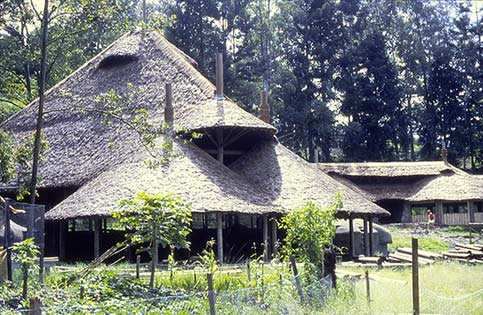
Far more interesting is the Raun Raun Theatre (right) which was being built in Goroka during my tenure. It is an interesting example of contemporary ferro cement construction and architecture and was completed in 1982.
The project architects were Paul Frame and Rex Addison.
The Raun Raun Theatre came into existence in 1975 at the suggestion of Professor Ulli Beier from the Insititute of PNG Studies.
"In early April, 1975, the Raun Raun Traveling Theatre was formed in Goroka with a grant from the National Cultural Council. A theatre truck was purchased with some help from the Goroka Rotary Club and housing was granted by District Authorities to accommodate drama students on the one hand and director/office on the other. The Theatre’s original function was to travel with ‘maket raun‘, a suggested scheme for taking public services, private sector activities and entertainment to a circuit of large village centres around the area."
Greg Murphy was the Director of Raun Raun Theatre and we had a close working relationship beween the School of Art and Design at Goroka Technical College and his company
The same ferro cement technique was applied to a number of houses elsewhere in the Highlands and I photographed several of these for an Air Niugini magazine article.

Subscribe to:
Posts (Atom)