Showing posts with label Eastern Highlands. Show all posts

Saturday, February 11, 2012

Gumi Races

Race Day - Local children with gumis
Photo: Roger Smith
For the uninitiated a 'gumi' refers to an inflated car or truck inner tube.  These were are are still used as a  flotation device to cross rivers in PNG and also for one of the more famous/infamous annual events in Goroka.  It should not be confused with a Japanese candy of a similar name.

'Gumiing' was the local verb for floating down the river on anything inflatable, be it an inner tube, raft or air matress

The Annual Gumi race took place on the Asaro River, the main water concourse in the Eastern Highlands.  It is a highlight of  a weekend of fun and revelry initiated and largely supported by the Hash House Harriers.  not only was their a race but it was beholden on the participants to dress up in the most garish costumes possible. There were single gumis, groups gumi rafts and the occasional local who joined in the fun.

It should also be noted that the Asaro is not by nature a peaceful river and can turn into a raging torrent after a good tropical downpour.  The rapids therefore provided a good deal of fun for the spectators and engendered an element of trepidation in the participants.

Riding The Rapids - Asaro River
Photo: Roger Smith
Many ensured they were suitably 'fortified' for the event' by strapping a large 'esky' (polystyrene chilly bin) full of 'stubbies' (beer) on to their rafts so they could quaff en route.

Pacific Helicopters were based in Goroka and I undertook a photographic assignment of the Gumi Race, strapped in and leaning over the skid of the chopper as the tubes careened down the river. The photos were used for Air Niugini's in-flight magazine - Paradise and if I recall correctly by Pacific Helicopters themselves?

The Single Gumi
Photo: Roger Smith
Post race the Harriers, other entrants and hangers-on partied at the Lantern Lodge where I played the electronic organ as background music from time to time.

The outer casing of old tires was also put to good use and it was common to see local children running them down the road as toys, with a couple of sticks inserted into the casing from either side(below)

Source: Brian - Papua New Guinea Photos 1972
Reference: 

Papua New Guinea Photos 1972
Enhanced by Zemanta

Friday, May 6, 2011

Making Fire

Making Fire - Eastern Highlands
Roger Smith, 1980
Dry moss (Old Man's Beard?) is used as tinder and and kept dry in a gourd.  The friction created by rubbing sticks together was traditionally used.

The slash and burn technique of agriculture was widely used to clear the bush and grasslands in preparation for crops.

Note the bilas decoration of the demonstrator which includes a toucan bill and pig tusks.

This photograph was taken in a village near to Goroka.
Enhanced by Zemanta

Tuesday, November 30, 2010

Rascals And The Lure Of Gold

There's gold in them there hills or at least there certainly is in various parts of Papua New Guinea.

When I was living there investigation for the new mine at Ok Tedi were under way and it was described as a mountain of copper with a gold cap, so rich were the prospects.

Flecks of gold could also be found in many of the Highlands rivers and panning for gold using an old wok was fun but not very lucrative.

On one of these excursions while a party of us were down by the river a group of rascals broke into the back of my locked land-cruiser and stole my large case of camera gear which included my precious Canon F1 camera.

The Last Men: Journey Among the Tribes of New GuineaThe term "rascal" refers to every type of criminal; from a petty thief to a murderer and opportunist theft such as this was very common place.

We all fell victims to rascals at some stage of our tenure in PNG.  In my first case it was awaking on Xmas Day morning to find that my landcruiser (beneath the house) had been jacked up on blocks and the four wheels stolen.

More disturbing was the level of violence one sometimes encountered. These were rare in my days in PNG and usually were carried out by small bands of disaffected youths.

On another occasion coming back in the land-cruiser, we were passing through a cutting when a large rock was thrown from the bank above, smashing a side window and narrowly missing the passengers in the back.

Tribal fights while sensationally reported in the western media were largely ritual affairs that did not impinge on the lives of expatriates.

Honour was satisfied when someone from an opposing tribe was either injured or killed in these skirmishes and in the main the weapons of choice were traditional - bows and arrows and clubs.

The injured were evacuated by PMV to Goroka Base hospital. I did see one unfortunate arrive by helicopter, lying sideways on a stretcher as the spear that had pierced his abdomen meant that he could not lie on his back.

Those members Eastern Highlands constabulary who came from tribal areas on the coast or in the islands, were loath to get too involved for fear of pay back, which could be swift and brutal.

Things have changed in the intervening years as the money from coffee has seen guns replacing traditional weapons and the level of violence has escalated dramatically.
Enhanced by Zemanta

Friday, October 29, 2010

The School Of Art And Design

Third Year Art and Design Students - 1980
The art school was part of Goroka Technical College in the Eastern Highlands. The Tech. also housed mechanical engineering and woodworking workshops for training Nationals to become tradesmen and a Secretarial College.

Students came from all over PNG to train at Goroka Technical College. In the case of the School of Art and Design we took secondary school graduates and prepared them for careers in media, advertsing and (in a few cases)careers as fulltime artists.

As Head of School I was supported by colleagues who came from the far flung corners of the earth. These even included a former lighthouse keeper from Canada.

Ken Kazanjian was young Philadelphia potter of Armenian descent who had been appointed by my Australian predecessor. While very much a free spirit, he did some marvelous work with students, building a free standing pottery using a combination of a traditonal Kunai grass thatched roof, timber frames and concrete foundations.

Inside the Pottery

Ken also constructed a large updraft kiln in which we fired the student's work. Having produced some ceramics myself I was aware of the Japanese anagama kilms and the one he built in Goroka was similar.

Some of the pottery graduates went to work in the Kainantu Pottery which was further down the Highlands Highway in the Eastern Highlands, travelling towards Lae.

Joseph Bin
Georg Schmidt was an equally passionate German sculptor who took 3D classes with students and Len Tindall, a British silversmith from Blackpool trained students in basic jewllery making. Len made a fine black coral and silver 'mask' pendant based on one of my sketched designs. I recall he was married to a Mauritian wife and when they "went finis" they resettled in Brighton or Bognor Regis.

The sole national tutor was Willie Stevens. Willi's main claim to fame was that he had designed the national currency. He was a charming man from Lalaua in  Milne Bay and highly regarded by the students who sort to emulate his success.

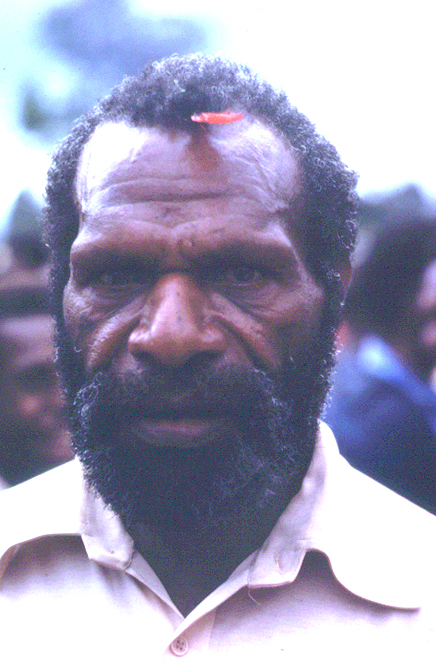
And I must not forget our trusty storeman Joesph Bin, an Eastern Highlander with a pierced septum (pictured right) and the ability to keep the students firmly under control.

As most of our art supplies had to be ordered months before from overseas and trucked up the Highlands Highway from the port of Lae it was a constant battle to stay within budget and keep programmes going, but manage we did.
Enhanced by Zemanta