Showing posts with label Roger Smith. Show all posts

Wednesday, May 6, 2020

The Photographer And Talair Memories

Roger Smith photographing Goroka Teacher's College performance - 1979
Its amazing what turns up almost 50 years later!

This photograph was taken by one of the Chard family in Goroka.  I was photographing an event and one of them (Nancy or Dave?) took this shot of me.

Dave and Nancy's son Gamu posted this on a Facebook site in 2020.

Talair - Goroka.  Photo: Peter Gillies
I often traveled in PNG on Talair flights, especially to the smaller centres such as Madang, Lae etc.  Always a lot of fun and sometimes 'seat of the pants' stuff, especially through the Daulo Pass.

Wednesday, May 27, 2015

Mudmen, Markets And Meris - Now Published


Living in Papua New Guinea
Mudmen, Markets And Meris
Living in Papua New Guinea - 1979 to 1981

by Roger Smith . Get a copy here.

Friday, May 8, 2015

Kainantu Pottery

Kainantu Pottery
Images courtesy of  Mary Watkins
The Kainantu Pottery was established by Muriel Larner in the Eastern Highlands Province.  Several of the graduate students from the School or Art & Design in Goroka went to work with Muriel.

Monday, December 31, 2012

Rabaul


Rabaulmixed media on canvas Roger Smith 1979
Rabaul    Mixed media on canvas       Roger Smith        1979
I produced this painting while still living and working in Goroka and gifted it to my friends from Wanganui, Michelle and Ean Cantell, who were living in Lae at the time I went 'finis'.

While rather abstract expressionist in style, it reflected my response to the the turbulent nature of the volcano that over looked the peaceful tranquillity of the bay and palms.

 As it turn out this proved to be rather prophetic as Rabaul's volcano (Tavurvur) is one of the most violent in the region and destroyed the town in 1994 when it erupted again.
Enhanced by Zemanta

Saturday, February 11, 2012

Gumi Races

Race Day - Local children with gumis
Photo: Roger Smith
For the uninitiated a 'gumi' refers to an inflated car or truck inner tube.  These were are are still used as a  flotation device to cross rivers in PNG and also for one of the more famous/infamous annual events in Goroka.  It should not be confused with a Japanese candy of a similar name.

'Gumiing' was the local verb for floating down the river on anything inflatable, be it an inner tube, raft or air matress

The Annual Gumi race took place on the Asaro River, the main water concourse in the Eastern Highlands.  It is a highlight of  a weekend of fun and revelry initiated and largely supported by the Hash House Harriers.  not only was their a race but it was beholden on the participants to dress up in the most garish costumes possible. There were single gumis, groups gumi rafts and the occasional local who joined in the fun.

It should also be noted that the Asaro is not by nature a peaceful river and can turn into a raging torrent after a good tropical downpour.  The rapids therefore provided a good deal of fun for the spectators and engendered an element of trepidation in the participants.

Riding The Rapids - Asaro River
Photo: Roger Smith
Many ensured they were suitably 'fortified' for the event' by strapping a large 'esky' (polystyrene chilly bin) full of 'stubbies' (beer) on to their rafts so they could quaff en route.

Pacific Helicopters were based in Goroka and I undertook a photographic assignment of the Gumi Race, strapped in and leaning over the skid of the chopper as the tubes careened down the river. The photos were used for Air Niugini's in-flight magazine - Paradise and if I recall correctly by Pacific Helicopters themselves?

The Single Gumi
Photo: Roger Smith
Post race the Harriers, other entrants and hangers-on partied at the Lantern Lodge where I played the electronic organ as background music from time to time.

The outer casing of old tires was also put to good use and it was common to see local children running them down the road as toys, with a couple of sticks inserted into the casing from either side(below)

Source: Brian - Papua New Guinea Photos 1972
Reference: 

Papua New Guinea Photos 1972
Enhanced by Zemanta

Saturday, May 14, 2011

News Of An Old Pupil

I was delighted to come across another blog site featuring the work of one of my former pupils, Larry Santana, or 'Larry Mike' as he was called when I taught him.

Larry was a third year student at the School of Art & Design in Goroka in 1979 and by far the most talented of his intake.

It would appear that he too is now treading the teaching path; at Tusbab High School in Madang.

Larry Santana - Madang

By all accounts he has had a tough life in later years while living in Port Moresby - loss of his advertising agency job and then his house, living in the notorious shanty area of Six Mile Dump and scavenging for food scraps.

It saddens me that he and his family had these experiences but at last he seems to be experiencing a much happier existence now, in Madang.

At least he has never lost his smile!

Larry Santana


Image source: Malum Nalu blog
Enhanced by Zemanta

Friday, May 6, 2011

Making Fire

Making Fire - Eastern Highlands
Roger Smith, 1980
Dry moss (Old Man's Beard?) is used as tinder and and kept dry in a gourd.  The friction created by rubbing sticks together was traditionally used.

The slash and burn technique of agriculture was widely used to clear the bush and grasslands in preparation for crops.

Note the bilas decoration of the demonstrator which includes a toucan bill and pig tusks.

This photograph was taken in a village near to Goroka.
Enhanced by Zemanta

Sunday, April 10, 2011

Food and Failures

The climate of Goroka was spring like all year around and as a result there was always and abundance of fresh vegetables to be found in the local market.

Being a central location the market was also the place to pick up a PMV (Passenger Motor Vehicle) for a trip further up or down the Highlands Highway.  While some of these were vans, many were open decked ISUZU trucks.

The Saturday market was one of the best and all of the activity took place in a designated area.  The first vendors could use the concrete slab tables and many preferred to set up on ground mats or the ubiquitous blue tarpaulins that were used for drying coffee.

Kau Kau - Goroka Market
Photo: Roger Smith
The local street potato was kau kau and somewhat coarser version of the New Zealand native tuber, the kumara.  Kau kau along with sago was a staple in the diet but this was supplemented with green leaf vegetables.

There were small piles of cabbages, broccoli and cauliflower in season. The buying process meant negotiating for a pile of what you fancied rather than an individual item of fruit or vegetable.  All were incredibly cheap in a subsistence economy founded on fertile soils.

One particular favourite were freshly cooked peanuts, still smoky in taste from the fire and costing ten toea in local moni. There were ten toea in one kina, the local equivalent of a dollar.

Sugar cane was also sold although I always found the chewing a piece less than satisfying.  Fresh carrots, capsicums and more exotic fare such as jackfruit could also be bought.

Goroka Market -  from left, cucumbers, tomatoes, sugar cane, potatoes and in front, kau kau
Photo: Roger Smith
One of the best purchases were the local bananas which grew throughout the highlands at this altitude. Pineapples were also be had and although small were delicious.  The same could be said for local passion-fruit.

Goroka Market - at back are limes and in the front jackfruit
Photo: Roger Smith
Goroka market is not all about food and there was a separate section for clothing where one could buy the colourful laplaps or container made out of local bamboo.

Next to the market was the local town butchery selling pork and chicken in large quantities. This was a controlled environment but most of the expatriate population chose to buy their meat from the supermarket in town.

Buying frozen food from the local supermarket could be counter-productive as there were frequent power cuts.  Most people had a back up petrol generator to keep their fridge and freezers going in the event of such an emergency.  Imported food while not cheap was often of the best quality.  I tasted some of the best frozen New Zealand fish that I have ever had in Goroka and at a similar price to buying it in the country of origin!

The plus side was that when the supermarkets own freezers malfunctioned they quickly sold off their food as hugely discounted prices.  Most of the power outages who be laid at the feet of those who were meant to maintain the large Ramu Valley power plant which supplied the Highlands electricity.  As its intakes in the Yonki Dam were slowly but surely silting up and maintenance was piecemeal (to be charitable), the long term prognosis for the plant was not great.

One of the biggest supermarkets in Goroka was owned by Collins and Leahy. They put in the first elevator while I was there and were inundated with local villagers who came from far and wide to try out this novelty; they spent all day going up and down the wondrous mechanical staircase without making a single purchase much to the annoyance of the staff.
Enhanced by Zemanta

Monday, November 22, 2010

Markham Moments

The first time I drove down the Markham Valley from the Eastern Highlands to Lae, I did so in a Toyota Corolla station wagon that I had purchased from a departing Expat who was going 'finis'.

The vehicle in question had been painted by the Goroka Tech. third year art and design students when, in a moment of generosity (or should that be weakness), I "donated" its surfaces to be a canvas for applied design.

The result was a handpainted wagon with brightly applied 'bilas' in a traditional PNG design.  There was nothing like it on the highway and the car attracted a lot of attention from the PMV's (Passenger Motor Vehicles) that plied their trade up and down the highway.

The other vivid recollection I have of this first journey in 1979 was that the Highlands Highway on the Markham Valley section had not yet been sealed, so the sensation of large undulating ruts and large potholes was quite unnerving.

Australian War Memorial 100546. Markham Valley,
New Guinea. 5 September 1943.Screened by dense smoke,
paratroopers of 503 US Paratroop Infantry Regiment
and gunners of 2/4th Australian Field Regiment with their
25 Pounders land unopposed at Nadzab,
during the advance of 7th Australian Division on Lae.
The Markham valley had been the scene of some fierce fighting on 5 September 1943, when US and Australian paratroopers dropped into it.

Their mission was to secure Nadzab airstrip in preparation for the Allies advance on Lae.  One paratrooper described exiting the plane as " like leaving an icebox and stepping into a furnace".

It was also unbearably hot in the valley when I traversed it and the only points of interest enroute were the traditional Zumim potteries found in the valley, with their wood fired and highly decorative cooking vessels.

The potting process is described thus:

Adhering to ancient tradition, the married, childless women of Zumim walk for ten miles to collect clay in secret from a special place, wrap it in banana leaves and walk the ten miles back to the village where, after a rest of a day, they will prepare it for use.

The clay is placed on a wet solid wooden board and beaten with a wet mallet until it spreads into a flat sheet. This is folded into a lump again and re flattened several times to remove impurities. 


When ready the clay is wrapped again in banana leaves and rested for several days before the skilled potters , the men take over forming the moistened clay in two long coils which they spiral around in a circular motion forming the new pot. The interior is then smoothed with a moistened piece of coconut shell. The upper rim is flattened with a paddle and decorations are etched on with fine silvers of bamboo and molded shapes can be applied which indicate the use for which the pot is made. 

Morobe dancers from Lae performing
at the Goroka Show.   Copyright Roger Smith
The pot will then be rested for a couple of weeks before being fired in several stages on open fires built under and over it. Pots are made ready for cooking or selling by firstly having yams or cooking bananas cooked in them in water until soft which seals the pot.

The embossed decorations on Zumim pottery, represent certain characteristics of nature. For example, the signs of a tracks of a mouse, the teeth of a lizard , a feather or seed pods. Pots with elaborate relief work of flying fox heads, birds and snakes are used for cooking meat and sometimes vegetables, whilst the plainer pots are used solely for cooking vegetables.


I bought a small zumim cooking pot which I kept for many years, eventually selling it in a NZ auction some twenty five years later.

Despite the challengs of of the Markham Valley the suspension of the station wagon held and the radiator did not boil on the return journey as we tackled the sharp incline from the valley floor, heading back towards Kainanatu.

I sold the station wagon shortly after this trek and purchased a Toyota short wheel base Landcruiser which was far better suited to the rough and off road conditions of the Highlands.

It was rumoured that less principled car owners wrote older cars off for insurance claim purposes by arranging for them to be 'stolen by rascals', or simply by finding a  convenient cliff face to push them off.  

The cost of repairs was often prohibitive and this sort of scam was I suspect not uncommon.
Enhanced by Zemanta

Monday, November 8, 2010

Sinofi Street

Creative Commons License: C. Frank Starmer
My first Goroka house was in Sinofi Street.

I remember it well as it was like every other government designed house, raised above the ground with stairwell access from a small lower level. Your vehicle was parked underneath the master bedroom.

There was a large section of grass with a few banana palms at the rear. The grass was cut by sweeping a hand blade in a scything fashion; rhythmic but sapping work in the heat of PNG.

Any banana that grew had to be wrapped either in a plastic bag or with fibre from the plant to stop the fruit being attacked by insects.

Most of the decorative plants that were planted were the tropical, indigenous varieties that commanded a premium in New Zealand garden centres, but which grew with wild abandon in their natural habitat.

It was not only the flora that grew in this fashion, the fauna did as well. We had large spiders that spread their webs.  These were Nephila pilipes (pictured right) and reportedly caught and consumed small birds?

All manner of bugs and beetles were new and foreign; stag beetles that hissed when threatened, cockroaches of enormous dimensions and even the odd snake, although the latter were not that visible most of the time.

I put the ants to good use by burying some decorative shells I had brought back from a trip to Rabaul. A month later when I dug then up they were completely clean of any internal organs and organic matter.

Shells picked clean
The house I was allocated by the Technical College had been previously occupied by a German engineer and his family called Helmut Helling. He moved from the Tech to work for Rothmans which had a large tobacco factory just out of Goroka.

It was not an uncommon occurrence for people to finish their government contracts and be lured by more lucrative deals in the private sector.

My neighbours on one side was a house full of Filipinos with a huge array of dogs that kept the neighbourhood awake whenever someone walked past at night.

Directly across from my house were Dave and Nancy Chard with their children Gamu and Emma. Dave was an Australian who worked for civil aviation and Nancy was a PNG national.It was from Nancy that I first learnt some of the secrets of Chinese cooking which became a passion of mine in later life.

Dave was a keen radio ham and I used to pop across from time to time to hear him converse with other amateur radio enthusiasts in countries thousands of miles away.

It was a must to purchase a receiver that could pick up the ABC on short wave. In the days before the internet this was the only way to learn what was happening in the big wide world as the PNG media mainly focused on domestic fare.
Enhanced by Zemanta

Friday, October 29, 2010

The School Of Art And Design

Third Year Art and Design Students - 1980
The art school was part of Goroka Technical College in the Eastern Highlands. The Tech. also housed mechanical engineering and woodworking workshops for training Nationals to become tradesmen and a Secretarial College.

Students came from all over PNG to train at Goroka Technical College. In the case of the School of Art and Design we took secondary school graduates and prepared them for careers in media, advertsing and (in a few cases)careers as fulltime artists.

As Head of School I was supported by colleagues who came from the far flung corners of the earth. These even included a former lighthouse keeper from Canada.

Ken Kazanjian was young Philadelphia potter of Armenian descent who had been appointed by my Australian predecessor. While very much a free spirit, he did some marvelous work with students, building a free standing pottery using a combination of a traditonal Kunai grass thatched roof, timber frames and concrete foundations.

Inside the Pottery

Ken also constructed a large updraft kiln in which we fired the student's work. Having produced some ceramics myself I was aware of the Japanese anagama kilms and the one he built in Goroka was similar.

Some of the pottery graduates went to work in the Kainantu Pottery which was further down the Highlands Highway in the Eastern Highlands, travelling towards Lae.

Joseph Bin
Georg Schmidt was an equally passionate German sculptor who took 3D classes with students and Len Tindall, a British silversmith from Blackpool trained students in basic jewllery making. Len made a fine black coral and silver 'mask' pendant based on one of my sketched designs. I recall he was married to a Mauritian wife and when they "went finis" they resettled in Brighton or Bognor Regis.

The sole national tutor was Willie Stevens. Willi's main claim to fame was that he had designed the national currency. He was a charming man from Lalaua in  Milne Bay and highly regarded by the students who sort to emulate his success.

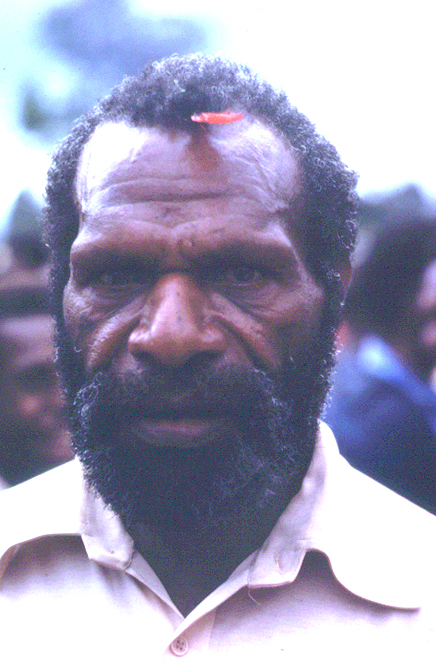
And I must not forget our trusty storeman Joesph Bin, an Eastern Highlander with a pierced septum (pictured right) and the ability to keep the students firmly under control.

As most of our art supplies had to be ordered months before from overseas and trucked up the Highlands Highway from the port of Lae it was a constant battle to stay within budget and keep programmes going, but manage we did.
Enhanced by Zemanta

Monday, October 25, 2010

A Life Changing Experience

Eastern Highlands Flag
In 1979 I left New Zealand to head Papua New Guinea's only regional art school in Goroka, Eastern Highlands Province.

Being younger and still idealistic I felt the need to experience truly living in an indigenous culture as one of a minority; the reverse of my then circumstances in Rotorua where I was teaching art at Lakes High School.

It was also the first time I had travelled out of New Zealand and spending a stop over night at the YMCA in Sydney was a revelation with some of the largest cockroaches I had ever seen.

It was in hindsight a good introduction to the fauna I would alter experience in PNG but no where near as exotic.

QANTAS was the carrier and in later years I flew back and forth on Air New Guinea, an airline that I undertook professional photographic assignments for as time allowed.

Landing at Jackson Airport, Port Moresby was also my first introduction to the oppressive humidity of a tropical climate. I can still recall the sensation of the humidity greeting me as a stepped down the gangway and on to the tarmac. There were no air bridges in those days and customs formalities took place in a large covered concourse with eating fans in the ceiling.

The domestic airline flights where carried out by both Air Nuigini and a private company, Talair. The latter were often referred to as "Crash Air" which was rather unfair as their safety record was as good as could be expected flying smaller fixed wing planes in and out of highland airstrips.

Landing would often take place in steeply inclined strips and if I remember correctly, Wabag was one of these. Take off was a sudden acceleration down the strip and over what appear to be a precipice.

Later I got to know several of the Nuigini Helicopter and Talair pilots and flew in the co pilots jump seat in the twin otter aircraft from Goroka to Madang and return, over the Ramu valley.

Approaching the Dalau Pass one could discern the glint of metal in the undergrowth, evidence of a previous air disaster where a plane had navigated incorrectly through the narrow entrance and into the low cloud and mist of the Highlands.

It was fun and seat-of-the-pants flying and many of the Talair pilots were Jumbo jet crew who came to PNG to fly in their holidays and get in some "real flying".

The pilots told tales of tribesmen who had never flown attempting to eat the hand wipe towelettes in the mistaken belief that these were the in-flight meal.


View Larger Map


I was determined not to lead an isolated expat existence and to get as much from my time in PNG as I could, mixing with the locals and learning their life and customs.  There had been people living in the Eastern Highlands for the past 18,000 years and the first Europeans only made contact in the late 1920's, so there was plenty of local culture to assimilate.

Papua New Guinea was a life changing experience in more ways than one. In the intervening thirty years I have come to realise how this first contract in the tropics changed my life forever.
Enhanced by Zemanta