Showing posts with label rascals. Show all posts

Wednesday, December 29, 2010

The Bird and Mudmen Bunkum

Asaro Mudmen, Port Moresby Cultural show
How myths are born
The Bird of Paradise is the national bird of Papua New Guinea and it is also the name of the best known hotel in Goroka.

Its closest rival during my time in the Eastern Highlands was the Lantern Lodge.  I used to play for my supper on the electric organ at the Lodge when the mood took me, not that it really mattered as the bar was always full and drinking was on most people's mind.

The Bird of Paradise had a gaggle of tribesmen and meris selling artifacts out the front as this was the main accommodation for the few tourists that passed through.

There were some good pieces to be had and recall a very nicely carved, clay pig whistle that I bought on the doorstep of The Bird.  A good set of a black palm bow and arrows could also be bought although the best were to be found out in the villages, which is where I purchased mine.

The traditional bows are strung with a strip of bamboo and are very powerful.  I tried mine out with a target in the back garden at Sinofi street and its impaled the cardboard target and supporting tree to a depth of ten centimetres.

The arrows are objects of beauty in their own right with various tips for hunting fish, birds and fighting other warriors.  the fish arrows resembled a mini harpoon with their splayed bamboo tip bound with fibre.

Later I purchased a second ceremonial bow from a different part of PNG.  This one was covered with woven orchid vine in red and white hues which made it quite a beautiful object.

I note that these days The Bird has joined the Quality chain which no doubt brings more bookings.  It still gets good reviews from travellers.  When I was there it was managed by an Australian and his Chinese wife who was very strict about maintaining standards.

They commissioned me to produce a portfolio of photographs of local scenes and activities to decorate the hotel's lounge.

Many tourists take in the much vaunted Asaro Mudmen tour while they are in Goroka.  I happen to know that the following is a load of conceived bunkum!

"Tribal folklore records that centuries ago the warriors of Asaro were defeated in a tribal fight with a neighbouring village. Honour compelled the men to retaliate with a “payback” raid, and, to make themselves look fierce in the process, covered their bodies with grey mud. According to legend, the ruse worked, and their enemies fled at the sight of these ghostly apparitions"

The late Tara Monighan, who worked for TransNiugini Tours at the time, was one hand when this "legend" was born and she recounted it to me.

The Asaro people were trying to find a way to look distinctive at a singsing ceremony and it was an expatriate Aussie who suggested that the local clay deposits be used over a cane frame to make the now "famed" Asaro masks.
The result as they say is the "stuff of legends" and has proved a nice little earner for the local tourism industry.

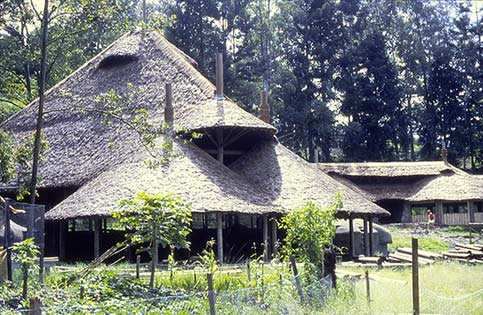
Far more interesting is the Raun Raun Theatre (right) which was being built in Goroka during my tenure.  It is an interesting example of contemporary ferro cement construction and architecture and was completed in 1982.

The project architects were Paul Frame and Rex Addison.

The Raun Raun Theatre came into existence in 1975 at the suggestion of Professor Ulli Beier from the Insititute of PNG Studies.

"In early April, 1975, the Raun Raun Traveling Theatre was formed in Goroka with a grant from the National Cultural Council. A theatre truck was purchased with some help from the Goroka Rotary Club and housing was granted by District Authorities to accommodate drama students on the one hand and director/office on the other. The Theatre’s original function was to travel with ‘maket raun‘, a suggested scheme for taking public services, private sector activities and entertainment to a circuit of large village centres around the area."

Greg Murphy was the Director of Raun Raun Theatre and we had a close working relationship beween the School of Art and Design at Goroka Technical College and his company

The same ferro cement technique was applied to a number of houses elsewhere in the Highlands and I photographed several of these for an Air Niugini magazine article.
Enhanced by Zemanta

Tuesday, November 30, 2010

Rascals And The Lure Of Gold

There's gold in them there hills or at least there certainly is in various parts of Papua New Guinea.

When I was living there investigation for the new mine at Ok Tedi were under way and it was described as a mountain of copper with a gold cap, so rich were the prospects.

Flecks of gold could also be found in many of the Highlands rivers and panning for gold using an old wok was fun but not very lucrative.

On one of these excursions while a party of us were down by the river a group of rascals broke into the back of my locked land-cruiser and stole my large case of camera gear which included my precious Canon F1 camera.

The Last Men: Journey Among the Tribes of New GuineaThe term "rascal" refers to every type of criminal; from a petty thief to a murderer and opportunist theft such as this was very common place.

We all fell victims to rascals at some stage of our tenure in PNG.  In my first case it was awaking on Xmas Day morning to find that my landcruiser (beneath the house) had been jacked up on blocks and the four wheels stolen.

More disturbing was the level of violence one sometimes encountered. These were rare in my days in PNG and usually were carried out by small bands of disaffected youths.

On another occasion coming back in the land-cruiser, we were passing through a cutting when a large rock was thrown from the bank above, smashing a side window and narrowly missing the passengers in the back.

Tribal fights while sensationally reported in the western media were largely ritual affairs that did not impinge on the lives of expatriates.

Honour was satisfied when someone from an opposing tribe was either injured or killed in these skirmishes and in the main the weapons of choice were traditional - bows and arrows and clubs.

The injured were evacuated by PMV to Goroka Base hospital. I did see one unfortunate arrive by helicopter, lying sideways on a stretcher as the spear that had pierced his abdomen meant that he could not lie on his back.

Those members Eastern Highlands constabulary who came from tribal areas on the coast or in the islands, were loath to get too involved for fear of pay back, which could be swift and brutal.

Things have changed in the intervening years as the money from coffee has seen guns replacing traditional weapons and the level of violence has escalated dramatically.
Enhanced by Zemanta

Monday, November 22, 2010

Markham Moments

The first time I drove down the Markham Valley from the Eastern Highlands to Lae, I did so in a Toyota Corolla station wagon that I had purchased from a departing Expat who was going 'finis'.

The vehicle in question had been painted by the Goroka Tech. third year art and design students when, in a moment of generosity (or should that be weakness), I "donated" its surfaces to be a canvas for applied design.

The result was a handpainted wagon with brightly applied 'bilas' in a traditional PNG design.  There was nothing like it on the highway and the car attracted a lot of attention from the PMV's (Passenger Motor Vehicles) that plied their trade up and down the highway.

The other vivid recollection I have of this first journey in 1979 was that the Highlands Highway on the Markham Valley section had not yet been sealed, so the sensation of large undulating ruts and large potholes was quite unnerving.

Australian War Memorial 100546. Markham Valley,
New Guinea. 5 September 1943.Screened by dense smoke,
paratroopers of 503 US Paratroop Infantry Regiment
and gunners of 2/4th Australian Field Regiment with their
25 Pounders land unopposed at Nadzab,
during the advance of 7th Australian Division on Lae.
The Markham valley had been the scene of some fierce fighting on 5 September 1943, when US and Australian paratroopers dropped into it.

Their mission was to secure Nadzab airstrip in preparation for the Allies advance on Lae.  One paratrooper described exiting the plane as " like leaving an icebox and stepping into a furnace".

It was also unbearably hot in the valley when I traversed it and the only points of interest enroute were the traditional Zumim potteries found in the valley, with their wood fired and highly decorative cooking vessels.

The potting process is described thus:

Adhering to ancient tradition, the married, childless women of Zumim walk for ten miles to collect clay in secret from a special place, wrap it in banana leaves and walk the ten miles back to the village where, after a rest of a day, they will prepare it for use.

The clay is placed on a wet solid wooden board and beaten with a wet mallet until it spreads into a flat sheet. This is folded into a lump again and re flattened several times to remove impurities. 


When ready the clay is wrapped again in banana leaves and rested for several days before the skilled potters , the men take over forming the moistened clay in two long coils which they spiral around in a circular motion forming the new pot. The interior is then smoothed with a moistened piece of coconut shell. The upper rim is flattened with a paddle and decorations are etched on with fine silvers of bamboo and molded shapes can be applied which indicate the use for which the pot is made. 

Morobe dancers from Lae performing
at the Goroka Show.   Copyright Roger Smith
The pot will then be rested for a couple of weeks before being fired in several stages on open fires built under and over it. Pots are made ready for cooking or selling by firstly having yams or cooking bananas cooked in them in water until soft which seals the pot.

The embossed decorations on Zumim pottery, represent certain characteristics of nature. For example, the signs of a tracks of a mouse, the teeth of a lizard , a feather or seed pods. Pots with elaborate relief work of flying fox heads, birds and snakes are used for cooking meat and sometimes vegetables, whilst the plainer pots are used solely for cooking vegetables.


I bought a small zumim cooking pot which I kept for many years, eventually selling it in a NZ auction some twenty five years later.

Despite the challengs of of the Markham Valley the suspension of the station wagon held and the radiator did not boil on the return journey as we tackled the sharp incline from the valley floor, heading back towards Kainanatu.

I sold the station wagon shortly after this trek and purchased a Toyota short wheel base Landcruiser which was far better suited to the rough and off road conditions of the Highlands.

It was rumoured that less principled car owners wrote older cars off for insurance claim purposes by arranging for them to be 'stolen by rascals', or simply by finding a  convenient cliff face to push them off.  

The cost of repairs was often prohibitive and this sort of scam was I suspect not uncommon.
Enhanced by Zemanta